

 English
  日本語
日本語  한국어
한국어  français
  Deutsch
  ไทย
ไทย  Español
  italiano
  português
  العربية
  हिंदी
हिंदी Tel
0571-28818756
 View More


In today's fast-paced retail environment, operational efficiency depends on accurate, real-time inventory visibility. Whether managing inventory for fashion apparel, cosmetics, consumer electronics, or pharmaceutical products, reliable data capture is essential to maintaining efficient retail operations.
At the heart of every RFID solution is the RFID inlay—the critical component that determines read performance and data reliability throughout the retail supply chain. However, not all RFID inlays deliver the same performance. Selecting an unsuitable inlay for challenging retail environments can result in inconsistent read performance, reduced inventory accuracy, and lower operational efficiency.
Retailers handling densely packed merchandise, liquid-filled products, or metal-packaged goods often encounter greater RFID deployment challenges. Choosing the right RFID inlay requires understanding how product materials, packaging, and environmental conditions affect RF performance. This guide explores the key considerations for selecting high-performance RFID inlays to help retailers achieve reliable inventory visibility across a wide range of retail applications.
RFID technology uses radio frequency signals to enable wireless communication between RFID readers and tags. While performance is typically excellent in open environments, retail products often introduce materials that affect RF signal propagation.
Among the most challenging materials for UHF RFID applications are metal and liquids. Metal surfaces can reflect radio waves, while liquids tend to absorb RF energy, both of which may reduce reading distance and overall read performance.
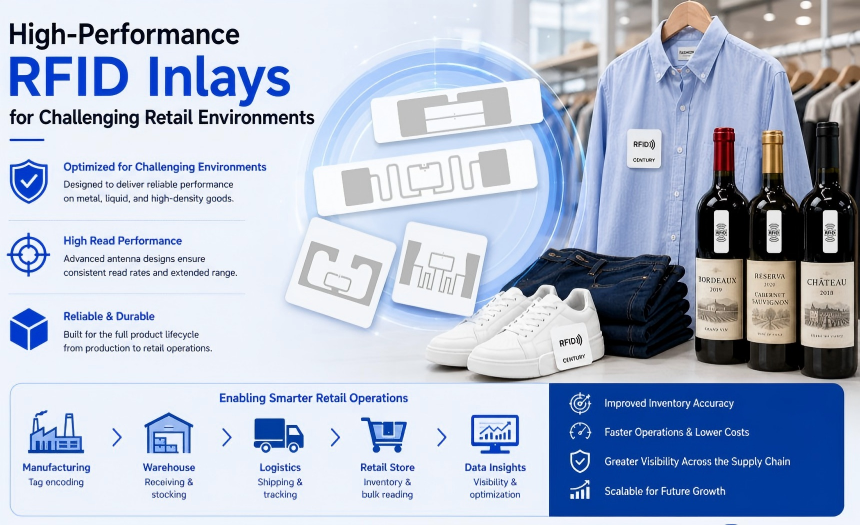
When selecting an RFID inlay, the material composition and packaging characteristics of the tagged product should always be considered. High-performance RFID inlays are specifically engineered to minimize detuning effects through optimized antenna design, enabling more consistent performance when applied to products containing metal components or liquids.
For retailers experiencing inconsistent reads or inventory blind spots, the issue is often related to selecting an RFID inlay that is not optimized for the specific product category or operating environment.
Selecting the appropriate RFID frequency is one of the first steps when deploying an RFID solution. The two most common RFID inlay types used in retail are High Frequency (HF) and Ultra-High Frequency (UHF).
Feature | HF (High Frequency) | UHF (Ultra-High Frequency) |
Operating Frequency | 13.56 MHz | 860–960 MHz |
Typical Read Range | Up to 1 m | Up to 10 m (depending on regulations and environment) |
Primary Applications | Access control, payment, NFC | Inventory management, retail, logistics |
Bulk Reading Capability | Limited | Excellent (hundreds of items simultaneously) |
Performance Near Liquids | Less affected | May require specialized inlay design |
For most retail inventory management applications, UHF RFID is the preferred choice because it supports long-range identification, non-line-of-sight reading, and efficient bulk reading of multiple tagged items. These capabilities significantly improve inventory counting, receiving, shipping, and store replenishment processes.
HF RFID and NFC technologies are better suited for applications requiring short-range, secure interactions, such as mobile payments, customer engagement, electronic ticketing, and access control.
Many retailers adopt a hybrid strategy, using UHF RFID to improve inventory visibility and operational efficiency while leveraging HF/NFC for customer-facing applications that require close-range interaction.
Choosing a high-performance RFID inlay involves much more than selecting a chip. The overall design of the inlay—including antenna performance, material compatibility, durability, and manufacturing consistency—directly affects RFID system performance throughout the product lifecycle.
When evaluating RFID inlays, retailers and solution providers should consider the following key factors:
A well-designed antenna is fundamental to RFID performance. Optimized antenna designs improve tag sensitivity, enhance read reliability, and support consistent performance even when products are densely packed or stacked together.
Century designs a wide range of RFID inlays with different antenna sizes and configurations to meet the performance requirements of various retail applications.
Different product materials affect RF performance differently. Products containing metal components, liquids, or high-density packaging may require specially designed RFID inlays to minimize detuning effects and maintain stable read performance.
Selecting an RFID inlay that matches the product material is essential for achieving reliable inventory visibility.
RFID inlays must withstand the physical demands of manufacturing, logistics, retail operations, and daily handling. Depending on the application, they may also need to tolerate heat, pressure, bending, or long-term storage.
High-quality RFID inlays are engineered to maintain stable performance throughout the product lifecycle under normal operating conditions.
Consistent manufacturing quality is critical to large-scale RFID deployments. Even small variations in antenna production or chip attachment may affect overall read performance.
Century implements rigorous quality control and performance verification processes to help ensure consistent RFID performance across every production batch.
Every retail application presents unique technical challenges. Product materials, packaging design, store environments, and operational workflows all influence RFID performance. As a result, a standard RFID inlay may not always provide optimal results.
Century offers customized RFID inlay solutions designed to meet specific application requirements. By evaluating product characteristics, packaging materials, and deployment environments, our engineering team can recommend suitable antenna designs, chip options, and inlay configurations to achieve reliable and consistent read performance.
Customization also helps simplify system integration. Selecting the right RFID inlay improves compatibility with RFID readers, software platforms, warehouse management systems (WMS), and enterprise resource planning (ERP) systems, helping businesses maximize the value of their RFID investment.
Through application validation and engineering support, customized RFID inlays help retailers improve inventory visibility, reduce operational errors, and enhance overall supply chain efficiency.
As retailers continue to accelerate digital transformation, RFID is becoming a fundamental technology for inventory visibility and connected retail operations.
Modern retail models—including omnichannel fulfillment, Buy Online Pick Up In Store (BOPIS), ship-from-store, and store-as-a-warehouse operations—depend on accurate, real-time inventory data. These applications require RFID inlays capable of delivering reliable performance across diverse retail environments.
Choosing high-performance RFID inlays today helps retailers build scalable RFID infrastructures that can support future business growth while reducing the need for costly hardware upgrades or system redesigns.
Century continues to invest in RFID antenna design, inlay development, and manufacturing capabilities to provide high-quality RFID inlays that meet the evolving requirements of global retail, logistics, healthcare, manufacturing, and industrial applications.
By selecting RFID inlays with proven performance, manufacturing consistency, and application-specific designs, businesses can establish a strong foundation for long-term inventory visibility and digital transformation.
Selecting the right RFID inlay is one of the most important factors in building a successful RFID solution. While chip performance plays a significant role, the overall inlay design—including antenna performance, material compatibility, durability, and manufacturing consistency—ultimately determines the reliability of inventory visibility and operational efficiency.
For retail applications involving apparel, cosmetics, consumer goods, pharmaceuticals, or other challenging environments, choosing an RFID inlay optimized for the specific product and application can significantly improve read performance and inventory accuracy.
As retailers continue to advance their digital transformation initiatives, high-performance RFID inlays provide the foundation for scalable inventory management, real-time visibility, and connected retail operations.
At Century, we are committed to delivering high-quality RFID inlays, RFID labels, and integrated RFID solutions that help businesses improve inventory accuracy, optimize supply chain operations, and accelerate their journey toward smarter retail.
With over 20 years of experience in EAS, RFID, and IoT technologies, Century provides end-to-end RFID solutions for retailers, logistics providers, manufacturers, and brand owners worldwide.
Our capabilities include:
✔ Independent RFID antenna and inlay design
✔ Comprehensive portfolio of RFID dry inlays, wet inlays, and RFID labels
✔ Customized RFID solutions for diverse industries
✔ Integrated RFID hardware, software, and IoT solutions
✔ Professional engineering and technical support
Whether you are deploying RFID in apparel, retail, logistics, healthcare, or industrial applications, Century helps you build smarter, more connected operations with reliable RFID technology.
Whether you are deploying RFID for apparel, cosmetics, logistics, healthcare, manufacturing, or industrial applications, selecting the right RFID inlay is the first step toward a successful RFID implementation.
Century offers a comprehensive portfolio of:
· UHF RFID Dry Inlays
· UHF RFID Wet Inlays
· RFID Labels
· Customized RFID Inlay Solutions
Our experienced engineering team works closely with customers to recommend the most suitable RFID inlay based on product materials, application environments, and performance requirements.
Contact Century today to discover the right RFID solution for your business.
- Official Page: www.century-cn.com
- Email: info@century-cn.com
Metal surfaces can reflect radio frequency signals, affecting the performance of standard UHF RFID inlays. For metal assets or metallic packaging, specially designed on-metal RFID tags are recommended to ensure reliable read performance.
A dry inlay consists of an RFID chip and antenna mounted on a substrate without adhesive.
A wet inlay includes a pressure-sensitive adhesive layer and release liner, allowing it to be easily converted into RFID labels for various applications.
Not always.
Different materials—including fabric, plastic, paper, glass, metal, and liquid-filled packaging—can affect RFID performance differently. Selecting an RFID inlay designed for the intended application helps achieve more reliable read performance.
Century combines inlay design, engineering validation, manufacturing, and quality control to help ensure stable and consistent RFID performance across production batches.
Our RFID inlays are developed to meet the performance requirements of various retail, logistics, and industrial applications.
UHF RFID supports:
· Long read range
· Non-line-of-sight identification
· Bulk reading of multiple tagged items
· Faster inventory counting
These advantages make UHF RFID the preferred technology for inventory management, logistics, and retail applications.
Yes.
Century offers customized RFID inlay solutions tailored to different industries and application scenarios. Our engineering team works with customers to recommend appropriate antenna designs, chip options, and inlay configurations based on product characteristics and deployment requirements.